Top 10 Vulnerabilities (OWASP 2025) Explained Simply, with Easy Memory Tricks
The OWASP Top 10 is the world's list of the most serious website security risks. Here's each one in a single sentence, a picture you won't forget, and the fix.
In this article (3 sections)ShowHide
- The 10 risks, the easy way
- 1. Broken Access Control: the wrong keys
- 2. Security Misconfiguration: doors left open
- 3. Software Supply Chain Failures: bad bricks from the supplier
- 4. Cryptographic Failures: secrets written on a postcard
- 5. Injection: a visitor's note becomes an order
- 6. Insecure Design: a bad blueprint
- 7. Authentication Failures: a weak lock
- 8. Software or Data Integrity Failures: unchecked deliveries
- 9. Security Logging and Alerting Failures: no CCTV, no alarm
- 10. Mishandling of Exceptional Conditions: panic in an emergency
- One sentence to remember all 10
- What to do next
OWASP is a non-profit group of security experts. Every few years they publish the top 10 vulnerabilities that hurt websites and web apps the most. The latest list is from 2025.
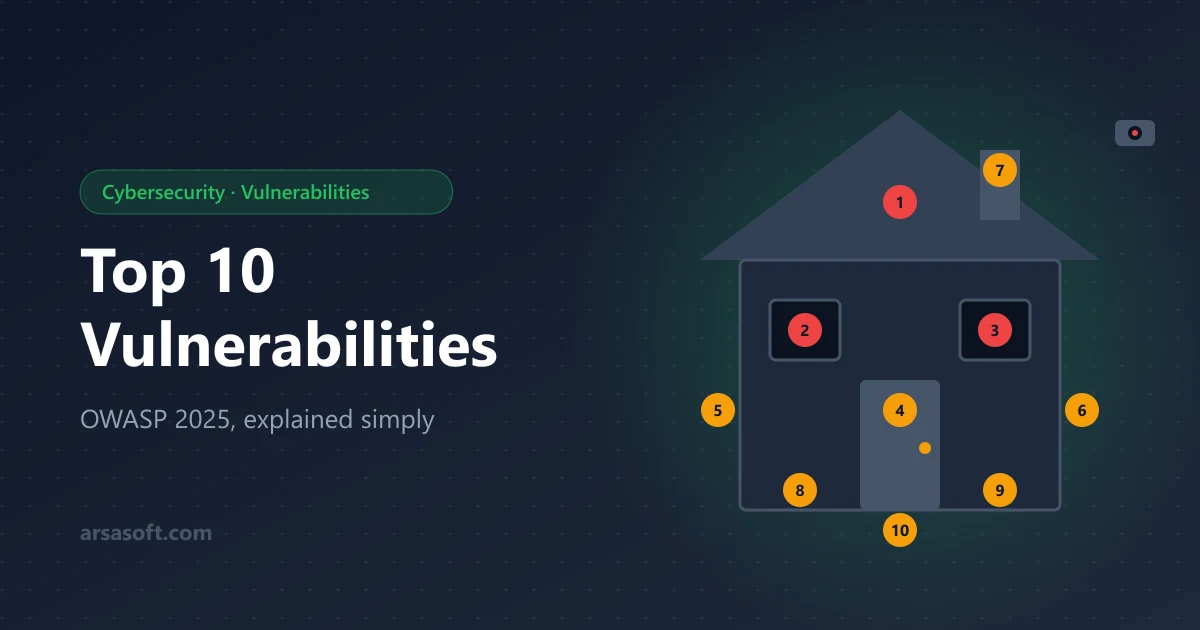
To make it easy to remember, picture your website as a house. Each risk is one weak spot in that house.
The 10 risks, the easy way
1. Broken Access Control: the wrong keys
A guest can open the owner's bedroom. In a website: a normal user can see someone else's orders or open the admin page just by changing the URL.
Fix: check permissions on the server for every request, not just by hiding buttons.
2. Security Misconfiguration: doors left open
Default passwords, error messages showing secrets, test pages left online.
Fix: change default settings, turn off what you don't use, and hide detailed errors on the live site.
3. Software Supply Chain Failures: bad bricks from the supplier
Your house is only as strong as the bricks you buy. A hacked or outdated plugin or package puts attackers inside.
Fix: use trusted packages, keep them updated and run composer audit or npm audit.
4. Cryptographic Failures: secrets written on a postcard
Passwords or card numbers sent without HTTPS, or stored with weak hashing.
Fix: HTTPS everywhere, password_hash() for passwords, and encryption for sensitive data.
5. Injection: a visitor's note becomes an order
The user types code into a form, and your system runs it (SQL injection, XSS).
Fix: prepared statements for the database, and escape everything you print.
6. Insecure Design: a bad blueprint
The plan itself is weak. Example: "forgot password" with no limit on attempts.
Fix: before building a feature, ask "how could someone abuse this?"
7. Authentication Failures: a weak lock
Easy passwords, unlimited login tries, no two-factor login.
Fix: limit login attempts, offer 2FA and block common passwords.
8. Software or Data Integrity Failures: unchecked deliveries
You accept updates or data without checking where they came from.
Fix: only install signed updates from trusted sources, and never trust data just because it "looks" like yours.
9. Security Logging and Alerting Failures: no CCTV, no alarm
Someone breaks in and nobody notices for months.
Fix: log logins, errors and admin actions, and get alerts when something looks wrong.
10. Mishandling of Exceptional Conditions: panic in an emergency
When something unexpected happens, the app crashes, shows secrets, or worse, lets the user in anyway.
Fix: handle errors carefully, show a simple message, and when in doubt, deny access.
One sentence to remember all 10
Take the first letter of each word, in order:
Always Secure Software Carefully; Intruders Instantly Attack Sites Lacking Monitoring.
| Letter | Risk | The house picture |
|---|---|---|
| A | Access control | Wrong keys |
| S | Security misconfiguration | Doors left open |
| S | Supply chain | Bad bricks |
| C | Cryptographic failures | Postcard secrets |
| I | Injection | Note becomes an order |
| I | Insecure design | Bad blueprint |
| A | Authentication | Weak lock |
| S | Software & data integrity | Unchecked deliveries |
| L | Logging & alerting | No CCTV |
| M | Mishandling exceptions | Panic in an emergency |
What to do next
You don't need to fix everything today. Start with the three that cause the most damage: access control (1), settings (2) and injection (5). For PHP websites, our PHP security checklist shows the code for most of these fixes.
Want someone to check your website against the OWASP Top 10? Talk to our team.
Source: OWASP Top 10:2025